


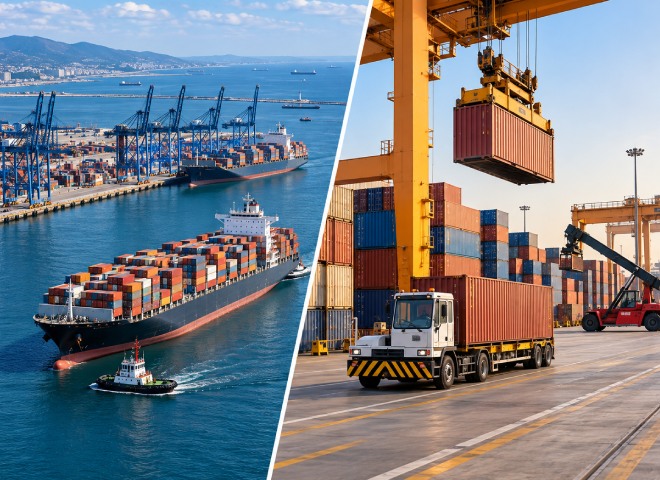
The shipping industry plays an essential role in stabilizing the economic growth of a country. This industry is growing rapidly because of the massive increase in the import and export of goods. Different means of transportation are used for importing and exporting goods.
In the shipping industry, some common terminologies are terminal, port, harbor, quay, pier, berth, and jetty. Everyone connected with the shipping industry needs to know about these terminologies. You may suffer a heavy loss if you don’t have clear concepts about the different terminologies used in shipping.
Besides other terminologies, Port and Terminal are widely used words. Most of us don’t know the difference between a port and a terminal. In this blog post, we’ll learn about these two terms.
What is a Port?
The landed area where boats and cargo take shelter is known as a port. A port acts as a point of trade where freight movements are negotiated. In other words, the port is vital in facilitating consumers within the harbor where a ship is parked for commercial use. Different activities of cargo shipment, i.e., offloading of goods and management of cargo, fixing different problems with shipments, or loading of passengers, take place at the port.
Various activities of different businesses take place at a port in a safe environment. A port plays an essential role at the land and sea boundary. In other words, a port acts as a meeting point where trains, trucks, or ships arrive to offload cargo and passengers. It is where exported products get loaded onto a ship or picked up as cargo from a ship.
Different countries have their ports along rivers. At ports, all activities are carried out under administration. The Port Authority is responsible for keeping prices and all activities under control. It is also responsible for ensuring the safety of goods. Besides this, the Port Authority is responsible for all construction and maintenance aspects of the ports’ international trade and transportation.
Types of Ports:
There are various types of ports depending on the goods. The most famous ports are:
- Fishing port
- Inland port
- Dry port
- Seaport
- Warm-water port
Benefits of Ports:
Ports in any country offer several benefits and play an essential role in growing that country’s economy. The benefits of ports are:
A country with ports is considered a developed country because thousands of laborers are directly connected with ports. At ports, there remains a need for workers to offload cargo. Bulky and oversized cargo can take weeks to move to a ship. Therefore, there always remains a need for more and more workers for fast and efficient work. Hence, ports offer employment opportunities to many laborers to provide food for their families.
Economic & Social Development:
There is no doubt that ports play a vital role in stabilizing the economic growth of any country. Also, ports help boost social links between two countries during international trade. If a country has more ports, it can have stable and strong social links with neighboring countries. In this way, the country’s GDP can boost in a brief time.
A Major Trade Point:
A port is an important trade center for a country. Different producers and consumers meet at ports for their trading purposes. Also, ports act as an important negotiation platform for traders by using various modes of technology.
What is a Terminal?
A terminal is where passengers and goods are loaded and unloaded. This is a place at a seaport where all types of offloading are done. There are many terminals at a seaport where the transfer of shipments takes place smoothly. At terminals, goods are transferred from semi-trucks/containers onto delivery trucks or vans to reach their final destination. Terminals have storage areas too, where cargo gets stored. Different types of activities, i.e., cargo and customs officials checking documents, take place at terminals.
Benefits of a Terminal:
The useful benefits of terminals are as follows:
Useful Boundary:
A terminal is a boundary between clients, port officials, and government agencies.
Identify Illegal Activities:
A terminal plays a vital role in identifying illegal activities because customs clearance and verification of documents take place at terminals.
The Distinction Between a Port and a Terminal:
A port is a station for performing various international trade activities, i.e., loading and unloading cargo.
Conversely, a terminal is a checkpoint at a port where shipments are carefully inspected and documented.
A port is a central station where all terminals may be present. It provides shelter for cargo, ships, boats, and port officials.
Terminals are specific places for particular activities involving shipments. There may be various terminals in one port according to the goods, i.e., oil and gas, construction material, automobiles, crude oil, and so forth.
Conclusion:
Ports and terminals have specific importance, and trading activities are impossible without their presence. They both play a role in boosting relations with neighboring countries and stabilizing the economy of a particular country. Therefore, all developed countries focus on making their ports and terminals more innovative.